Cooling Patch Formula Example and Production Process
The main structure of the cooling patch is divided into three parts: the base non-woven fabric, the main gel layer and the anti-adhesive layer. The hydrophilic gel in the gel layer has a good energy conversion function, which can stimulate the cold receptors of the nerve endings to produce a cold sensation. After applying the cooling patch, the heat on the skin will be absorbed by the polymer gel layer and dissipated through vaporization, achieving the purpose of continuously taking away the body's heat. The cooling time of the cooling patch is generally more than 6 to 8 hours.
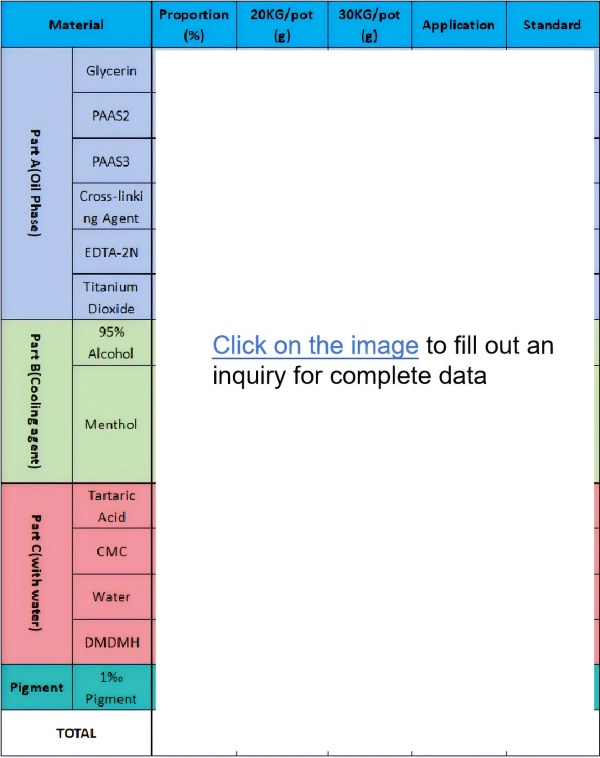
Formula example
Technical solution for fever-reducing patch (brief description)
Features and Examples
-High viscosity, firmly adheres without falling off
-No mint, no irritation, can also be used by pregnant women
-Long-lasting mild cooling feeling
-Thermochromic, visible fever, visible fever
-Easy to operate, compatible with existing equipment
-Low cost, high cost performance
-High colloid strength, no glue overflow on the edge
-Safe and non-toxic materials
Know-How
Principle:
Sodium polyacrylate cross-links under the action of aluminum ions to form a three-dimensional water-retaining glue layer. It is coated on the non-woven fabric and release film layer by special coating equipment and solidified into an elastic hydrogel layer. After the gel layer contacts the skin, it softens the stratum corneum and continuously pushes the active components into the human body.
Reversible thermochromic pigments are prepared from electron transfer organic compound systems. Electron transfer organic compounds are a type of organic color-producing system with a special chemical structure. At a specific temperature, the molecular structure of the organic matter changes due to electron transfer, thereby achieving color change. This color-changing substance is not only bright in color, but also can achieve color changes from "colored to colorless" and "colorless to colored" states.
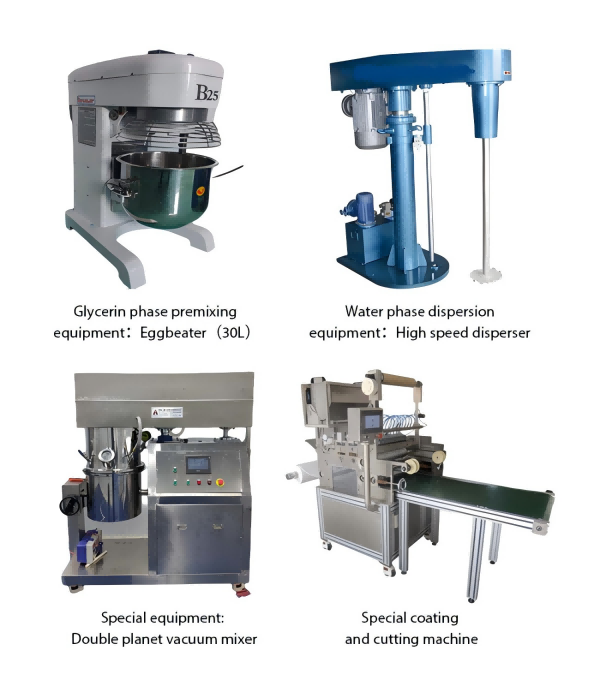
Required Equipment
Materials and Formula
Operation Steps
Process Parameters:
Video Introduction
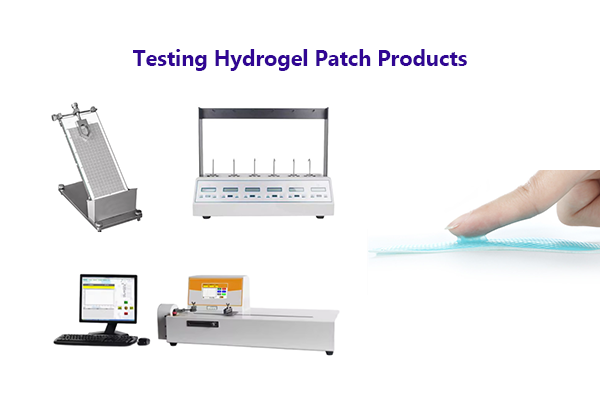
General Tools and Equipment for Testing Hydrogel Patch Products